
How To Reduce Knee Osteoarthritis Pain & Optimize Your Function


We see many people with knee osteoarthritis here at PhysioPlus Health Group. Often, clients come in with little hope and believe that there is nothing that they can do for their pain. But there are things that we can do to help you manage your pain and improve your function.
A knee osteoarthritis diagnosis, or any osteoarthritis diagnosis for that matter, does NOT mean that you need to stop doing the activities that you love to do or need to do. Our experienced physiotherapists can help you use exercise and movement to manage your symptoms. Through movement and exercise, you can minimize your pain and maximize your abilities.
What is osteoarthritis?
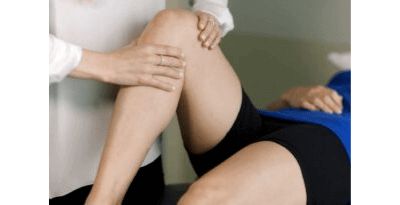
Osteoarthritis is a condition that can have a significant impact on your life. While osteoarthritis can affect many different joints, the knee seems to be the most frequently affected. Contrary to what you may think, osteoarthritis is a disease of the WHOLE joint, not just the cartilage. Nevertheless, knee osteoarthritis can impair your functioning and ability to do valued daily activities. This could be due to pain and/or limitations, such as weakness.
Unfortunately, there is no cure for osteoarthritis. However, there are things that you can do to:
- Manage your pain
- Prevent disability
- Improve your function
- Avoid progression of your symptoms
But how?
If you have knee osteoarthritis, you could benefit from these core treatments.
- Exercise
- Weight management
- Self-management of symptoms
These treatments are the first line of defense before moving onto more medical and invasive treatments. These treatments reman imperative if you are receiving medical and more invasive treatments as well.
Self-Management Strategies That You Could Use to Manage your Knee Osteoarthritis
- Identify challenges associated with your osteoarthritis
- Set realistic and achievable goals
- Plan to overcome obstacles
- Monitor your progress
Role of Weight Management to Manage Knee Osteoarthritis Pain and Improve Function
Studies show that merely a 5kg weight loss can decrease your risk of knee osteoarthritis by 50%!
Likewise, the Arthritis Foundation notes that losing 1 pound can take 4 pounds of pressure off your knees!
However, ensure that you are maintaining healthy body weight through a nutritious diet and appropriate exercise.
Role of Exercise in Managing Your Knee Osteoarthritis Pain and Improving your Function
Exercise seems to be the most effective non-surgical treatment for knee osteoarthritis! One type of exercise doesn’t show to be better than others per se. But… supervised exercise shows to have more benefits than home-exercises.
Exercise can help:
- Increase your muscle strength
- Stabilize your joints
- Improve your range of motion
- Reduce your levels of pain
- Optimize cardiorespiratory fitness
- Enhance the quality of your cartilage
All these benefits ultimately boost your level of function, promote independence, and allow you to continue to do the activities that you value.
What Types of Exercise Will Help Your Knee Osteoarthritis?
Almost any exercise is good and will have benefits. You should do a combination of different types of exercise to get the biggest bang for your buck. By adopting a well-rounded exercise routine, you can improve your muscle mass, cardiovascular fitness, and improve joint stability.
- Strength Training – strengthens your muscles and increases muscle mass
- Examples: muscle-strengthening exercises
- Aerobic Exercise – enhances your cardiovascular fitness
- Examples: walking, cycling, swimming
- Neuromuscular Training – improves motor control to stabilize your joint
- Why? Helps with your pain and reduces instability and functional limitations
- Examples: functional exercises that involve various joints and muscle groups
GLA:DTM to Manage Hip and Knee Osteoarthritis
The GLA:DTM program is an education and exercise-based program that helps manage symptoms and loss of function. It is evidence-based in the most up-to-date hip and knee osteoarthritis research and led by certified healthcare professionals.
If you have mild, moderate, or severe hip or knee osteoarthritis, you may be eligible to participate in the GLA:DTM program. GLA:DTM is a neuromuscular training program developed in Denmark. It is an 8-week program that involves 12 neuromuscular training sessions, and 2-3 education sessions.
View this post on Instagram
Can you participate in the GLA:DTM program if you are awaiting surgery for hip or knee osteoarthritis?
Both hip and knee osteoarthritis lead to muscle weakness for many people. The GLA:DTM program improves strength and movement patterns. Thereby GLA:DTM can reduce your symptoms of hip and/or knee osteoarthritis. Additionally, this program is beneficial if you are awaiting surgery. Evidently, if you are stronger before surgery, you can have better outcomes following surgery. So, the GLA:DTM program can prepare you for post-surgical rehabilitation and get you back to doing your daily activities faster.
What can you expect from the GLA:DTM program?
Before you participate in the GLA:DTM program, you will need to undergo a health assessment. This will include some functional tests and a physical assessment conducted by a healthcare professional.
In the GLA:DTM program, you will do exercises to help enhance your joint stability and motor control. Moreover, you will learn how to maintain this stability and control throughout your day.
Also, the program includes education sessions where you will learn about the joint degeneration process that goes with progressing osteoarthritis.
Typically, the GLA:DTM program is an hour-long group exercise class. Including a 10-minute warmup, followed by circuit training, and then concluded with a 10-minute cooldown. During the circuit training section, you will challenge your…
- Core stability
- Posture and balance
- Leg strength
And engage in functional training exercises.
Exercises that You Can Do to Help Manage Your Knee Osteoarthritis Pain
1. Mini Squat
- Stand straight with your hands supported on the back of a chair.
- Slowly bend your knees to about 45 degrees
- Your knees should track over your 2nd toe
- Keep your heels down and feet flat on the ground
- Hold for 6 seconds.
- Push through your heels, contract through your gluts to bring you back to standing.
- Repeat 15x.

2. Standing Backward Leg Slide
- Stand straight with your arms stretched in front of you and hands supported on the back of a chair.
- While keeping the toes on the ground, slide the right foot back.
- You should feel your right glut muscles tighten
- Slide right foot back to be parallel with the left
- Repeat with the left foot sliding back.
- Repeat 15x on each leg.
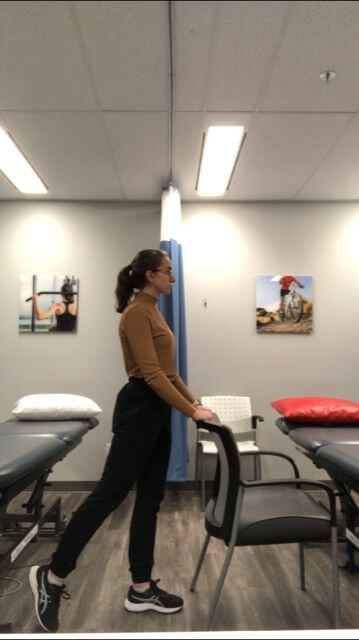
3. Quad and Calf Stretch
- Stand straight with your arms stretched in front of you and hands supported on the back of a chair.
- Step back with the right foot while bending the left knee.
- Your weight should be shifted to the left foot.
- Make sure that your hips are level and facing in front of you.
- You should feel a stretch in your right thigh and hip.
- Hold for 20 seconds.
- Repeat with the left foot stepping back.
- Repeat 2x on each leg.

4. Knee Extension
- Sit in a chair.
- Plant one foot on the ground and extend the other leg until the knee is straight.
- Relax and repeat with the other leg
- Hold for 5 seconds, repeat 10x
- If this is too easy, tie and loop a resistance band around your ankles and try the exercise with resistance.
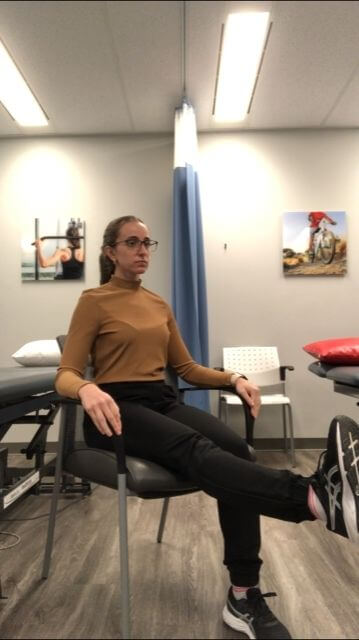
5. Knee Flexion
- Sit in a chair.
- Plant one foot on the ground and bend the other knee so that the foot slides under the chair.
- Flex the moving knee as much as you can.
- Return the foot to be parallel with the other.
- Repeat with the other foot.
- Hold for 5 seconds, repeat 10x.
- If this is too easy, tie and loop a resistance band around your ankles and try the exercise with resistance.

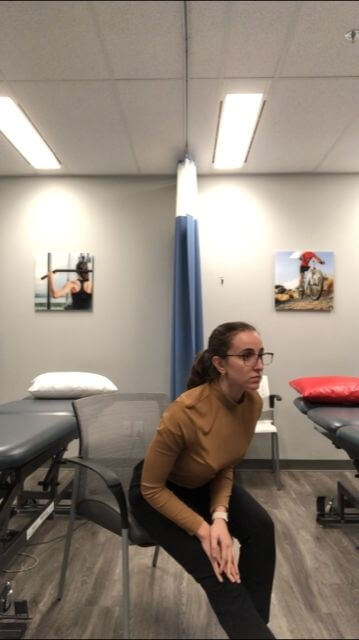
6. Hamstring Stretch
- Sit on edge of chair.
- Slide one heel out so that your knee is straight, toes are pointing up.
- Place your hands on your thigh of your straight knee.
- While keeping your back straight, stick your buttocks out toward the back of the seat, hinge at your hips, and bring your chest toward your thigh.
- Hold for 20 seconds then relax.
- Repeat 2x on each leg.
Pain Management During Exercise
If you have pain during exercise that may be ok. It doesn’t necessarily mean that you are damaging your joints or muscles. Nevertheless, you do not want your pain to increase more than 3 points on a scale of 0-10.
This scale refers to your level of pain. So, a score of 0 would mean no pain at all and a score of 10 refers to the worst pain imaginable.
If you start your exercise with a 2/10 pain level, then you don’t want your pain to increase past a 5/10 on that scale. It is better to scale back your exercise…work at a lower intensity or modify the activity if your pain increases too much.
By pushing your pain too far, you may cause a flare. If this flare does happen, stop the aggravating activity until your pain returns to what it was before you started the activity. You can then problem-solve to figure out how to prevent another flare.
What if you have other health conditions in addition to knee osteoarthritis?
Oftentimes, people with osteoarthritis have other health conditions. For example, you may also have hypertension, diabetes, and/or other health conditions . If you have another health condition, you may need to take precautions with exercise.
With hypertension, you want to avoid high-intensity exercises so as to not spike your blood pressure to dangerous levels.
If you have diabetes, you should monitor your glucose levels before and after exercise. You should also monitor your feet for injuries to avoid foot ulcers. Treat foot ulcers accordingly if they arise.
Regardless of any other health conditions, make sure that you monitor your symptoms before and after exercise and seek assistance from a healthcare professional if need be.
So, where should I start?
Knee osteoarthritis is rather frustrating and unfortunately, we can’t wave a magic wand and cure you. The good news is that through strategies such as exercise, you can reduce your pain and optimize your function. Exercise is safe and effective for people with knee osteoarthritis.
Start with the exercises above and consider the GLA:DTM program as part of your care.
Remember to be aware of your symptoms before, during, and after exercise. Also, consider that your pain should not skyrocket during exercise. Exercise can help you strengthen surrounding musculature. Thereby, stabilizing your joints and allowing you to move efficiently. It can also help maintain or improve so many other aspects of your wellbeing. For example, exercise can improve your cardiorespiratory fitness, enhance your mood, increase/maintain your bone density, and so much more.
Don’t stop moving, but learn how to identify when you are doing too much!
References
- “6 Exercises for Knee OA Pain.” Arthritis Foundation. Accessed November 4, 2020. https://www.arthritis.org/health-wellness/healthy-living/physical-activity/other-activities/6-exercises-for-knee-oa-pain.
- Ageberg, Eva, and Ewa M. Roos. “Neuromuscular Exercise as Treatment of Degenerative Knee Disease.” Exercise and Sport Sciences Reviews 43, no. 1 (January 2015): 14–22. https://doi.org/10.1249/jes.0000000000000030.
- Bartels, Else Marie, Carsten B Juhl, Robin Christensen, Kåre Birger Hagen, Bente Danneskiold-Samsøe, Hanne Dagfinrud, and Hans Lund. “Aquatic Exercise for the Treatment of Knee and Hip Osteoarthritis.” Cochrane Database of Systematic Reviews, March 23, 2016. https://doi.org/10.1002/14651858.cd005523.pub3.
- “Education and Exercise.” GLA:D Canada. 2016 GLA:D Canada, n.d. https://gladcanada.ca/index.php/what-is-glad-canada-2/.
- Juhl, C., R. Christensen, E. M. Roos, W. Zhang, and H. Lund. “Impact of Exercise Type and Dose on Pain and Disability in Knee Osteoarthritis: A Systematic Review and Meta-Regression Analysis of Randomized Controlled Trials.” Arthritis & Rheumatology 66, no. 3 (March 2014): 622–36. https://doi.org/10.1002/art.38290.
- Melvin, J. Stuart. “Walking: The Best Way to Start Getting Active with Arthritis.” Arthritis-Health. Veritas Health, LLC, November 20, 2019. https://www.arthritis-health.com/blog/walking-best-way-start-getting-active-arthritis.
- Skerrett, Patrick J. “Exercise Is Good, Not Bad, for Arthritis.” Harvard Health Blog. Harvard Health Publishing, June 9, 2020. https://www.health.harvard.edu/blog/exercise-is-good-not-bad-for-arthritis-201305086202.
- “What Is Osteoarthritis?” Osteoarthritis Research Society International. 2013 Osteoarthritis Research Society International, November 15, 2016. https://oarsi.org/what-osteoarthritis.
FAQ
How do I progress my exercises once these ones get too easy?
Once your exercises get easier, it means you are getting stronger. You should definitely progress your exercises. If you are keeping the same exercises, you could progress how long you do these exercises for (i.e. increasing repetitions, sets, or holding time) or how hard you are working (i.e. increase intensity). Don’t progress both aspects at once. Chose one form of progression and see how your body responds. Maybe try the other form of progression the next time.
Can I go for walks with knee osteoarthritis?
Definitely! Walking is a great activity to increase your cardiorespiratory fitness, improve your mood, promote healthy bone density, etc. It is low impact, so it won’t put undue compression forces on your knees. It is a very functional activity…and it’s free! The Canadian Guidelines for Physical Activity recommend that you should get a total of 150 of moderate-intensity exercise per week. If you walk every weekday, that’s only 30 minutes of walking per day. If that is too much, start walking for less time and increase your time when that gets easier.
I appreciate that walking is good for me, but it hurts too much! What can I do instead?
If walking is too painful for you and you do not currently feel comfortable walking for exercise, try aquatic exercise. When you do exercise in the water, you feel weightless due to the buoyancy of water. This makes aquatic exercise non-weight bearing and puts less of a compressive force on your joints. Aquatic exercise is shown to improve pain, disability, and quality of life for people with knee osteoarthritis. It can help with joint pain, while still working on strength and cardiorespiratory fitness.