
What is the GLA:D Program and how can it help treat my arthritis?


As you get older, hip pain and knee pain can be extremely hard to deal with. Hip and knee pain can make it very difficult to do every day activities such as walking, and getting up and down stairs. It can also make it hard to do exercise and lead a healthy, active lifestyle.
Hip and knee pain can be caused by osteoarthritis. Osteoarthritis is the gradual breakdown of the hip or knee joint, leading to pain and inflammation.
Thankfully, there are many ways hip and knee pain can be treated. Our trained chiropractor can help treat your hip or knee pain through exercise programs like the GLA:D program, hands-on therapy, bracing, and self-management strategies.
What is Osteoarthritis?
Osteoarthritis is a very common reason why many people may develop hip pain or knee pain as they get older.
If the following symptoms are familiar to you, you may have developed osteoarthritis:
- Your hip or knee feels stiffer in the morning
- Your hip or knee feels like it cannot get a full range of motion
- Your hip or knee feels like it pops, clicks, or catches slightly when moving
- Your hip or knee gets painful and swollen after activity
Osteoarthritis is one of the main reasons why people get hip and knee replacement surgeries. In fact, in Canada in 2020, about 70% of all hip replacement surgeries and almost 100% of knee replacement surgeries were due to osteoarthritis.
It’s important to have a trained chiropractor or physiotherapist assess your joints if you suspect you have osteoarthritis because there are many ways to help treat it and prevent you from needing surgery.

What is the GLA:D Program?
The GLA:D Program is an education and exercise course run by our trained chiropractor or physiotherapist to help treat hip and knee pain from osteoarthritis. It was first developed in Denmark – but due to its success in helping treat osteoarthritis, it is currently being run worldwide!
Can the GLA:D Canada Program help treat my hip and knee pain?
Yes! The aim of the GLA:D Program is to help treat hip and knee osteoarthritis and to get you back to being able to do the things you love to do. It contains some of the best exercises that treat hip and knee pain.
Contact our clinic if you think that the GLA:D program may be something you are interested in! ‘Our chiropractor will assess your hip or knee and they can determine if the GLA:D program is right for you. If it is, you will then undergo a series of exercise tests so you can track your progress as you go through the program.
How does the GLA:D Program work?
The GLA:D Program runs for six weeks, with exercise sessions twice a week. Your chiropractor or physiotherapist will supervise your exercise sessions to make sure they are right for you, and that you are doing them safely and with good form.
As the weeks go on and you get stronger, your chiropractor or physiotherapist will slowly make the exercises more and more difficult. This will allow your muscles to get stronger and for your body to adapt to more difficult activities!
The GLA:D Program also has two educational sessions, where you will learn more about your hip pain or knee pain. You will learn about what osteoarthritis is, and many helpful strategies to help manage your pain!
What are some best exercises for hip pain and knee pain?
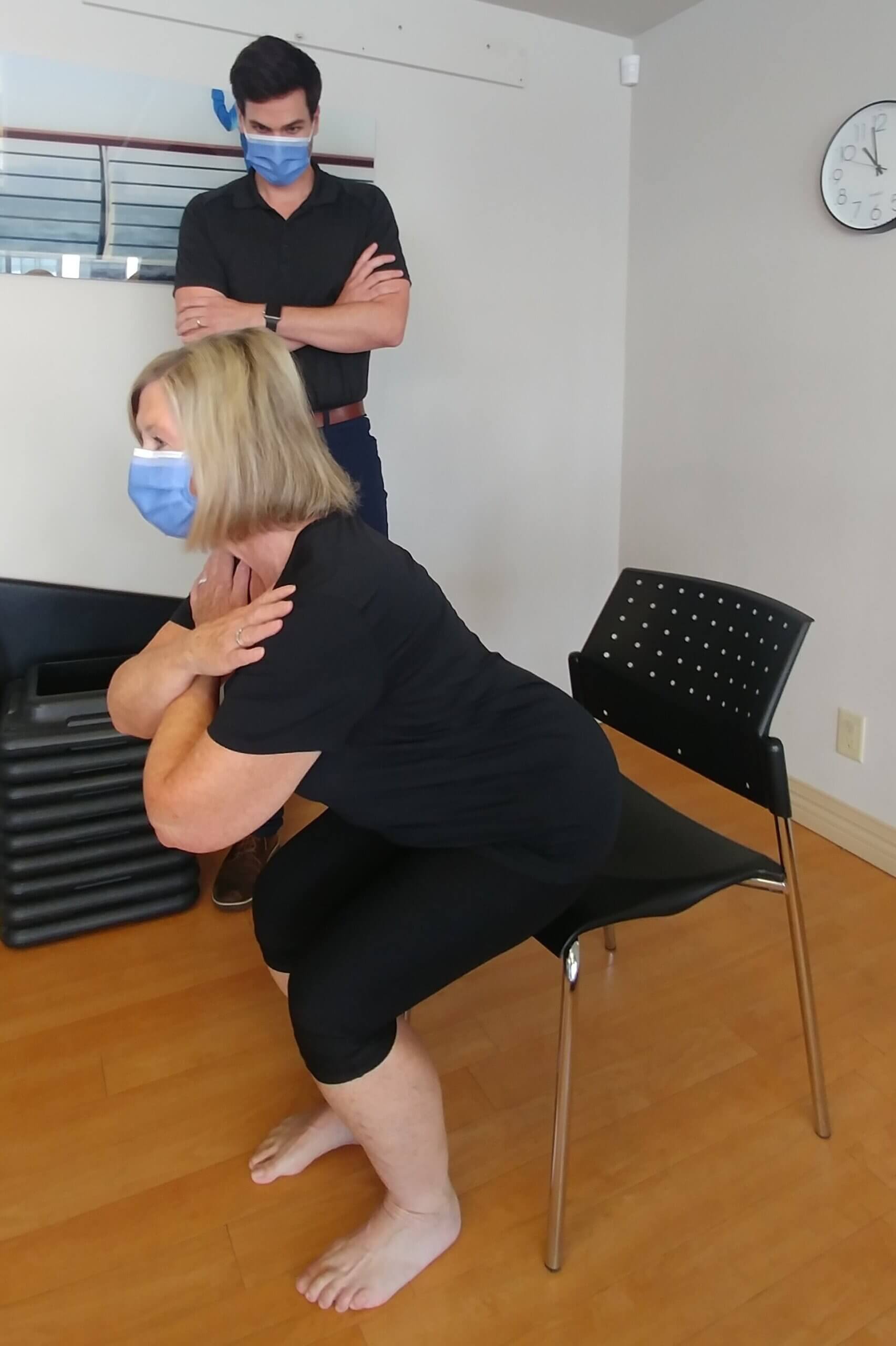
Here are a few examples of the exercises you will be doing in the GLA:D Program. Your chiropractor will supervise each session, and they will customize or modify each exercise to ensure that it is the right level of difficulty for you!
1. Chair Squats
With a chair behind you and against the wall, slowly lower yourself down into the chair. Don’t sit fully, but when your bottom touches the chair, stand back up!
2. Knee Extension
Sitting in a chair with a band or weight around your ankle, slowly straighten your knee. Then, slowly bring it back.
3. Knee Curls
Sitting in a chair with a band around your ankle with your leg straight, slowly bend your knee and allow it to straighten again.
4. Foot Slides
While holding onto something stable, place a towel or slide board under one foot. Then, slowly slide out to the side, while keeping your weight on your other foot.
5. Step Ups
Using a step, step up and down multiple times on each leg.
What are some other ways I can manage my hip and knee pain at home?
It is important to stay active and exercise to help keep your muscles strong and your joints healthy. It is okay to feel a bit of pain with exercise, but it shouldn’t be too much for you to handle!
1. Walk
Walking can be a great way of getting exercise. Start small and slowly build up to longer and longer walks!
2. Heat
Placing a hot pack on your hip or knee when it is feeling sore can help improve blood flow and make it less painful.
3. Keep a pain journal
Write down activities you do each day, and how painful your hip or knee gets after or during each activity. This journal can help you figure out how much activity your body can tolerate. It can also help you slowly make your exercises and activities more difficult to allow your body to get stronger!
Our trained chiropractor can help you create personalized strategies to help deal with your hip or knee pain. They can also help monitor your pain levels, and help determine how much your body can tolerate. They will help ensure you can safely get back to the activities you love to do!
This blog was written by James Ma, a Physiotherapy student at the University of Toronto.

FAQ
How do I know my hip pain or knee pain is from osteoarthritis?
Your hip pain or knee pain may be from osteoarthritis if:
- Your hip or knee feels stiffer in the morning
- You notice you cannot move your hip or knee as far, and there is some clicking or catching
Your doctor may prescribe an X-ray or MRI to confirm, and your physiotherapist can perform an assessment of the joint.
Can bracing help my knee pain?
Wearing a brace can be a good strategy to help make activities such as walking, going up or down stairs, or exercising less painful. Braces provide support and stability to the joint. Your physiotherapist can help find a brace that is right for you!
Can injections help with osteoarthritis?
Your body contains natural fluid within each joint, to help keep things moving smoothly. One part of the fluid is hyaluronic acid (HA). HA injections can be a good strategy to help manage osteoarthritis pain if other forms of painkillers or exercise seem to not be helping. Your doctor can help determine if this may be beneficial for you.