
How to Choose the Best Lower Back Brace for You


Trying to find a brace for your low back pain can be a confusing task.
Do you find yourself overwhelmed by the many different styles, sizes, materials, and levels of support that are offered? If so, you’re not alone!
Some of the most common questions I get from my patients are “when should I wear a low back brace?” and “how do I choose the right one?”
Well… if you’re wondering the same thing, you’ve come to the right place!
What is a Low Back Brace?
A low back brace is a device that can be worn to support your low back. In certain cases, it may be offered to relieve back pain, prevent injuries, promote healing, or help improve your posture.
A chiropractor or physiotherapist may suggest a back brace for the following reasons:
- To support your spine following an injury or surgery.
- To support your posture during heavy lifting or sports.
- To support your spine during work or everyday activities.
Back bracing is most effective when used in combination with chiropractic or physiotherapy treatment to help relieve low back pain.
Choosing the Right Brace
It’s best to follow the recommendations of your doctor, chiropractor, or physiotherapist when choosing a back brace. However, here are a few things to keep in mind:
Level of support
Back braces can be rigid, semi-rigid, or flexible.


Rigid braces offer the highest level of support and are often used to stabilize your spine following surgery or traumatic accidents such as fractures or disc herniations. Because of the hard, unbendable material, a rigid brace may be the most suitable if you are suffering from severe pain, or if you require very little movement of your spine.

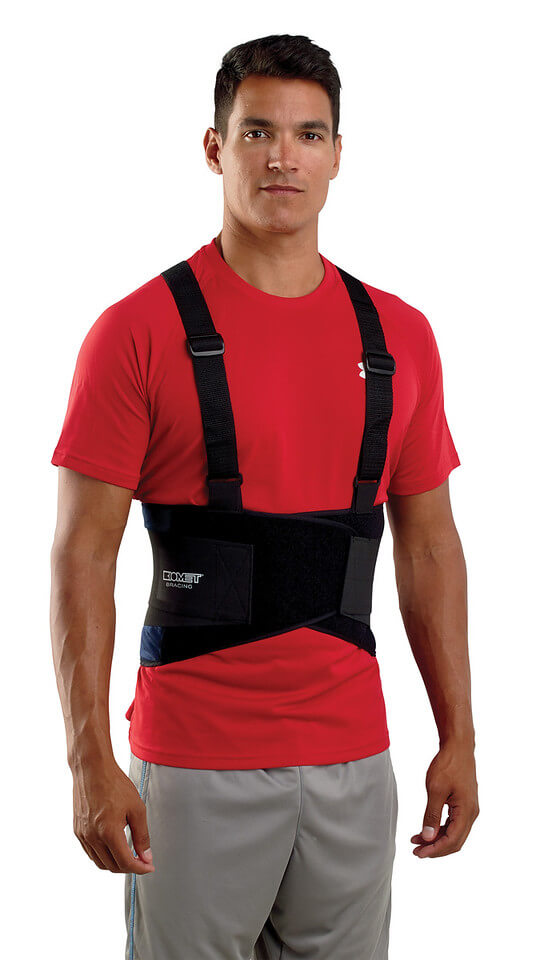
Flexible braces are often seen as the most practical because they allow you to move more freely. They are made of softer materials that limit excessive movements and provide compression while offering more flexibility than a rigid brace. Oftentimes flexible braces are suggested if you have mild pain but need a little extra support during exercise or your daily activities.


Semi-rigid braces offer the benefits of both. They feature the supportive elements of a rigid brace while allowing the movements of a flexible brace. Sometimes the added rigid supports are removable, allowing you to customize the level of support depending on your needs.
Adjustability
It’s important to find a back brace that fits you well. Most of the over-the-counter braces come in a universal size with hooks or straps that can be adjusted to customize the fit and level of support. You can also get custom braces made that are molded to your body.
Material
If you have any fabric allergies or sensitivities, it’s important to take this into account when choosing your brace. Flexible braces are often composed of softer materials such as canvas, cotton, elastic, or neoprene, while rigid braces may be made of plastic, leather, or metal.
Maintenance and durability
If you’re going to be wearing your brace frequently, having a machine-washable brace can make it easier to keep clean.
“I find that the durability of braces is dependent on the type of material. For example, braces with Velcro straps may wear out quicker than braces with hooks or straps, while braces made with flexible material may stretch out over time.” – Michelle DeMarchi
Extra features
In addition to the styles, support, and materials offered, back braces may have special features such as:
- Therapeutic magnets – therapeutic magnets are designed to increase circulation which helps to promote healing and improve pain.
- Mouldable material – some braces may offer custom mouldable panels that allow you to mold the brace to your body shape. Other braces may have inflatable panels that allow you to adjust the pressure on specific areas of your back.
- Massage component – some braces incorporate electric massagers that can help relax tense muscles, reducing pain and stiffness.
- Hold and cold therapy – these braces have a pocket for hot or cold packs. This allows you to relieve pain, stiffness, and inflammation through the use of hot or cold packs without having to take off your brace.
Healthcare practitioner recommendation
Regardless of your condition, injury, or severity of pain, it’s important to always consult your doctor, chiropractor, or physiotherapist before using a brace.
Which one is right for you?
It’s actually easier than you think to choose one.
Tweaked your back playing tennis with the kids? Then maybe the flexible brace is right for you.
Does your pain fluctuate day-to-day? You might need a semi-rigid brace.
Is your pain more severe, requiring you to have a high level of support? The rigid brace is the way to go.
Talk to a physiotherapist today
Contact us today to book an appointment…or ask about a free 20-minute consultation with one of our physiotherapists or chiropractors. They will give you honest Back Pain advice and guidance on if a back brace is right for you.
This blog was written by Emily Karageorgos, a Physiotherapy student at the University of Toronto
FAQ
How long should you wear a back brace?
It all depends on the type of brace and the injury. Back braces should not be seen as a long term solution, however there is no set guideline on how long you should wear one. Oftentimes your chiropractor or physiotherapist many recommend to only use the back brace when your pain is at its worst. It’s often encouraged to take the brace off occasionally throughout the day so that your back muscles to not become reliant on the brace.
Should you wear a back brace to bed?
It’s usually not recommended to wear a back brace to bed. When you are sleeping, your back doesn’t need to stabilize your body as much against gravity. However, there are certain conditions, such as scoliosis, where a night brace may be recommended. It is best to consult with your chiropractor or physiotherapist before using a brace at night.