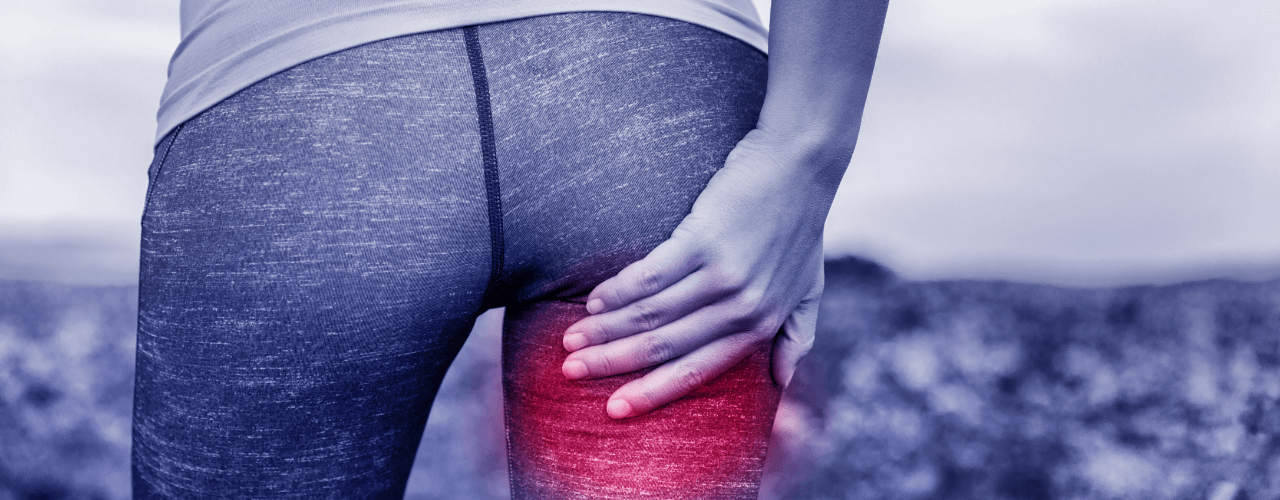
WHAT IS SCIATICA?
The term sciatica is typically used to refer to this, sometimes, excruciating pain that radiates into the buttocks and down the back of the leg. However, it is mostly a descriptive symptom rather than an actual diagnosis.
Sciatica is typically the term used to describe pain, discomfort, weakness, etc. from irritated nerves, nerve compression, or inflammation in structures (i.e. muscles) anywhere along the sciatic nerve pathway. This can cause your pain to radiate down your leg along sciatic nerve pathway.
WHAT ARE THE SIGNS AND SYMPTOMS OF SCIATICA?
Here are the 6 signs and symptoms of sciatica that can help you figure out if you may have sciatic nerve pain:
- Pain
Because sciatica involves compression or irritation of a nerve, it produces sharp pain down your leg along the course of the nerve.
This pain usually feels different from other dull or achy pain that you might feel if you have a muscle strain or soreness localized to that specific muscle.
Sciatica radiates into the leg, sometimes all the way down your leg to the foot. It can feel like a shooting pain and sometimes also described as a burning pain, even though you are not next to anything hot!
You can also feel low back pain…but it is usually less severe than the pain down your leg. Read here about low back pain caused by herniated discs and how it may cause neurological sciatic symptoms.
2. Numbness or Tingling
Along with pain, you may find changes in your sensation. This can be in the form of numbness (loss or reduced sensation), or tingling (that “pins and needles” sensation). Your area of numbness may follow a specific pattern unique to one of the 5 nerves that is irritated.
Three of the common pain patterns of sciatica are the L4, L5 and S1 nerve roots. Here are the pain and numbness locations associated with specific nerve levels:
L4: outside of the thigh and inside of the lower leg
L5: buttock down the leg to the outside of the ankle and top of the foot and toes.
S1: buttock to the back of the thigh, into the calf and outside of the foot.
Your chiropractor or physiotherapist can help diagnose the cause of your sciatica and tell you which level may be affected.
3. Weakness
Your muscles can be affected by sciatica too. If you’ve noticed any difficulty lifting your foot off the floor, this may be caused by sciatica. This is because the sciatic nerve also carries the motor signals from your brain to your legs through the sciatic nerve.
If you’ve trouble walking or feel more fatigued with movement, it is a good idea to see your chiropractor or physiotherapist for a comprehensive assessment before it gets any worse.
4. Posture Related Symptoms
Sciatica symptoms may flare up when you are in different positions, such as sitting, standing, bending forward, or even coughing and sneezing! This is usually the case when the sciatica is caused by a herniated or damaged disc in the spine.
Some positions put stress on the disc and can make the symptoms worse. Likewise, coughing or sneezing can increase the pressure in the body and aggravate the disc more. Your chiropractor and physiotherapist are well trained in distinguishing what positions make your pain worse and can offer you strategies for immediate relief!
5. One-sided Pain
Although we have two sciatic nerves (one for each leg), sciatica is commonly only experienced on one side. Some people will get sciatica on the right side, and some on the left…there isn’t a bias with sciatica. It really just comes down to what the underlying problem is that’s causing the pain.
One of the causes of sciatica is arthritis (or “degeneration”) of the spine and discs, however, it is hard to determine what side of the body will experience symptoms.
Alternatively, if your sciatic pain is caused by tight muscles compressing the nerve, then the pain will always be experienced on the same side.
For example, one cause of sciatica is from a condition called piriformis syndrome. The piriformis is a muscle in the buttocks that helps with the rotation of the hips. The sciatic nerve can run below, above or through this muscle, and it can sometimes become irritated here to cause sciatica.
If the piriformis is tight, it can cause compression of the sciatic nerve and cause pain down the leg. If this is the cause of your sciatica, then the side of the tight piriformis will always correspond with the side you experience symptoms.
For example, if you have a tight left piriformis muscle, then pain and numbness will be experienced on the left side. This is because the piriformis directly compresses the sciatic nerve as it exits the buttocks and irritates the nerve!
6. Reflexes
You don’t know it, but you’re probably already familiar with the L4 reflex. It is the reflex that is tested at the doctor’s office when they strike the front of your knee with a small hammer. Reflexes are important because they tell us about the transmission of nerve signals. They are the body’s involuntary response to certain actions done to the body.
If the sciatic nerve is irritated, then the body may not be able to elicit the involuntary response as normal. Having a reduced or absent reflex in the legs may be a sign of your sciatica, and you should see your healthcare practitioner for an assessment.
What causes sciatica pain?
Sciatica is caused by irritation and/or inflammation of the nerve roots that exit from the lumbar spine region of the back. The most common cause of irritation is a herniation of the disc; bone spurs from degenerative changes or some type of injury. The sciatic nerve starts in your lower back and runs down your legs to your feet.
Sciatica pain is usually experienced on one side/leg and typically affects people between the ages of 30 and 50, but it is possible for younger and older people too.
Although sciatica is often described as a pinched nerve, most cases stem from inflammation. A compressed nerve in the lower back is typically a more severe condition and should be addressed as soon as possible.
The good news is that most people recover from a bout of sciatica. The bad news is that a majority of people will have more than one episode, and often the condition gets worse each time. At PhysioPlus Health Group in Toronto, our physiotherapist will address your symptoms, but more importantly, we will get to the root of the problem and provide you with the tools to resolve your pain and prevent it from returning in the future!
Can Physiotherapy or Chiropractic TREATMENT help my sciatica?
Sciatica is commonly thought of as a painful condition, but it can also affect mobility, strength, gait, and balance. It is very important to seek out a physiotherapist or a chiropractor for help.
Our therapists will perform a comprehensive examination to gauge your body’s range of motion, any weaknesses, the location and quality of the pain, and any other changes to your typical functioning. It is also important to test the nerves’ function and mobility to identify any restrictions or limitations.
Our therapists will customize your treatment plans to address your specific situation and sciatica-related symptoms. Our therapists may use targeted manual therapy techniques and specific mobility exercises to reduce stiffness in your tissues and mobility in your joints.
We will also educate you about your particular condition and exercises to practice at home. These exercises are meant to assist your muscles to become stronger and less tense.
Our top objective is to assist you in finding relief from sciatica pain so that in no time at all, you’ll be back to living your life!
WHAT EXERCISES HELP RELIEVE SCIATIC PAIN?
Child’s Pose
Contrary to the name, Child’s Pose can be done by people of all ages to stretch their spine and relax their body.
Cobra Pose
Cobra pose can be a great way to stretch out your lower back and reduce the compression in your spine so that your sciatic nerve is less irritated.
Pigeon Pose
This stretch works to stretch your hips and glutes to relieve muscle tension that might be contributing to your sciatic pain.
Standing Hamstring Stretch
Your sciatica could be flaring up because the muscles in the back of your thighs, known as your hamstrings, can influence tightness and pain in your lower back. With this stretch, you can decrease this lower back tightness which reduces stress on the sciatic nerve.
It’s important to remember that each person is different, so only a licensed physiotherapist can assess you and give you specific treatment advice on what to do to manage your specific sciatic issue.
Please stop the stretches if you feel more pain or discomfort. Reach out to a health professional if you need further help.
WHAT ARE THE THINGS TO AVOID IF YOU HAVE SCIATICA?
- Avoid lifting heavy objects
If you’re experiencing lower back pain, it’s important to take a break from activities that increase your pain. For most, lifting heavy objects can cause irritation. Lifting heavier objects is a functional task that is needed for many of your activities of daily living, whether that be carrying your groceries or carrying your backpack.
- Avoid sitting still for too long
You’ve probably heard a lot about having “good posture” while sitting at your desk. However, the truth is that sitting in any one position for too long can cause you to feel stiff. Motion is lotion! Try incorporating 1 minute stand breaks into your day every 30 mins- hour.
- Avoid sleeping on your stomach
Sleeping on your stomach increases the pressure on some of the joints in your lower spine which may be irritating if you have a history of low back pain. If you are experiencing low back pain, try sleeping on your back with a pillow under your knees. If you are a side sleeper, sleep with one pillow between your knees.
- Avoid wearing high heels
When you wear high heels, your center of gravity shifts forward forcing your low back to arch slightly more than normal. Over time, this can cause the muscles in your pelvis, back and legs to become tight which may irritate your back pain. If you are experiencing back pain, its best to opt for a low or no heeled shoe.
- Avoid bedrest
When your back hurts, it may seem like lying down and resting is the best way to heal. However, prolonged inactivity can actually make you feel more stiff and may increase your pain. Instead, try incorporating gentle low-impact activity into your day such as light walking or stretching.
DO I NEED TO GET IMAGING (MRI, XRAY, CT SCAN) BEFORE MY APPOINTMENT?
If you have imaging results please bring the reports with you to your appointment as it will help our specialist provide you with a more complete and accurate care plan. But don’t worry if you haven’t had imaging because our specialist will refer you to get any imaging if it’s needed.